Chain of Custody
Chain of custody (CoC) means a documented, unbroken record of who owned, handled, or processed a material from its origin to its final form. For urban wood, that means tracing a tree from removal to finished lumber — with evidence at every step.
Loggistics automates this documentation. By recording sources, logs, and products in the system, you generate a complete CoC record that can be shared with buyers, auditors, and certification bodies.
The four-stage pipeline
Every log in Loggistics moves through four stages in order:
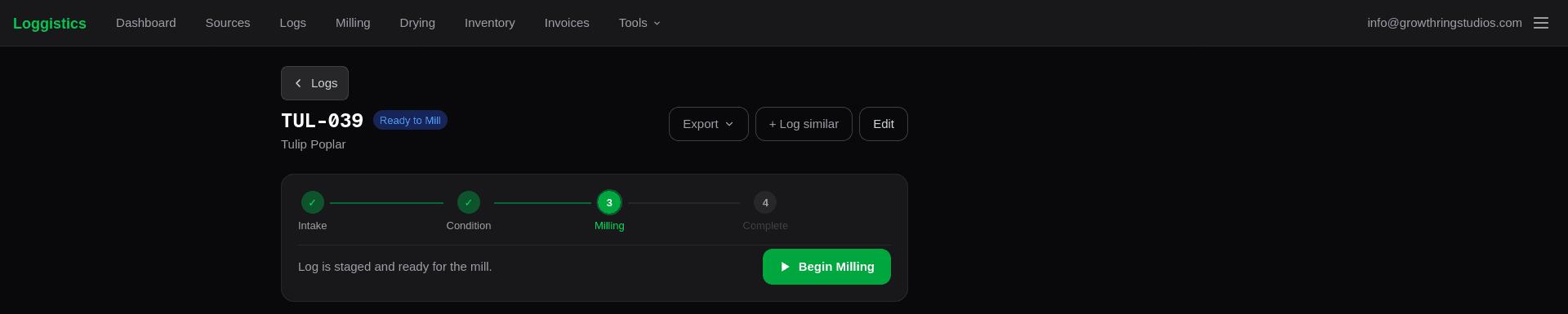
1. Intake
The log has been received at your yard. Basic information is recorded:
- Parent source (the removal event)
- Species
- Dimensions at intake
- Scaling method and volume estimate
The log is in your inventory but not yet queued for milling.
2. Condition
The log has been inspected and staged. Additional information is recorded:
- Defect count and notes
- Sub-location in your yard
When the log is physically ready to mill, use Mark as Ready to advance it to the next stage. This signals to your team that the log is queued.
3. Milling
An active milling session is open. As you cut the log, boards and other products are entered one by one with their dimensions and grade. The session tracks:
- Running board-feet total
- Product count by type
- Sticker and firewood yield
Products get their IDs during this stage. The milling session is also where the date of processing and the location (your yard or a specific sub-location) are recorded — this matters for USRW documentation.
4. Complete
All products from the log have been entered and the milling session is closed. The log’s record is now a full chain-of-custody document covering:
- Where the tree came from
- Why it was removed
- When and where it was milled
- Every board, slab, and product that came from it
What the chain covers
Source record
  ├── Removal address and date
  ├── Who removed the tree
  ├── Removal reason (demolition, decline, hazard, etc.)
  └── Species confirmed at removal

  Log record
    ├── Intake date and dimensions
    ├── Your yard's location (from Settings)
    └── Milling session
          ├── Date milled
          ├── Sawyer / operator
          └── Products
                ├── ASH-007-B01 — dimensions, grade
                ├── ASH-007-B02 — dimensions, grade
                └── ASH-007-S01 — dimensions, grade
Public CoC pages
Every source, log, and board has a public-facing page that requires no login. These pages are designed to be shared with buyers and are linked from QR codes printed on your tags.
A buyer who scans the QR code on a board sees:
- The board’s species, dimensions, and grade
- The log it came from
- The source removal record (address, date, removal reason)
See Sharing & QR Codes for how to generate and print these links.
Standalone acquisitions
Sometimes lumber arrives at your yard without a full log on file — boards purchased from another sawyer, donated material, or wood received before you started using Loggistics. These are recorded as standalone acquisitions (ACQ-XXXX).
Standalone acquisitions still generate chain-of-custody documentation — they just have a shorter chain. You can link them to a parent log later if the information becomes available.
For USRW certification, a complete source record (with removal address, reason, and confirming arborist) produces a higher score than a standalone acquisition. If the removal details exist, it is worth creating the full source record.